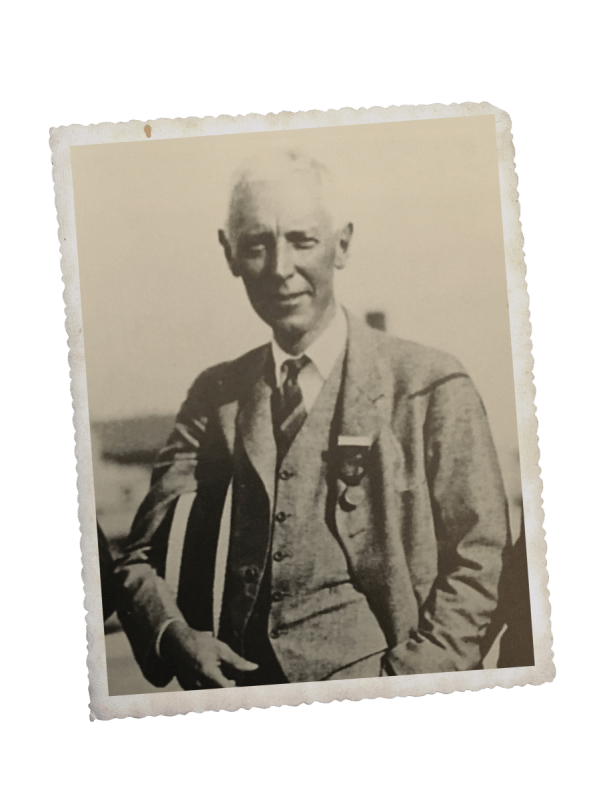
Herald Benjamin (“Harry”) Greening was born in Hamilton in 1880, and first visited Muskoka in 1881. It was the beginning of a lifelong relationship with boats and Muskoka.
As a young man, he entered the family business, The B. Greening Wire Company in Hamilton.
The early 1900s were an auspicious time for the rapid advancement of the airplane, automobile, and the powerboat, all of which relied on the internal combustion engine.
While the airplane and automobile attracted commercial attention, the development of the powerboat was advanced mainly by individuals.
Harry’s first adventure in power boating was a result of a frustrating portage in Muskoka. He met the challenge, building a three-horsepower engine which powered his canoe at 9 mph in 1904.
In the decade that followed, Harry was off to the races in his Gadfly series of four boats, each more powerful and faster than the last.
The best were yet to come.
While there had been remarkable advances in engines, endurance and reliability remained elusive. An American industrialist donated a gold cup to the winner of three 50-mile heats. Adjustments and repairs were not permitted.

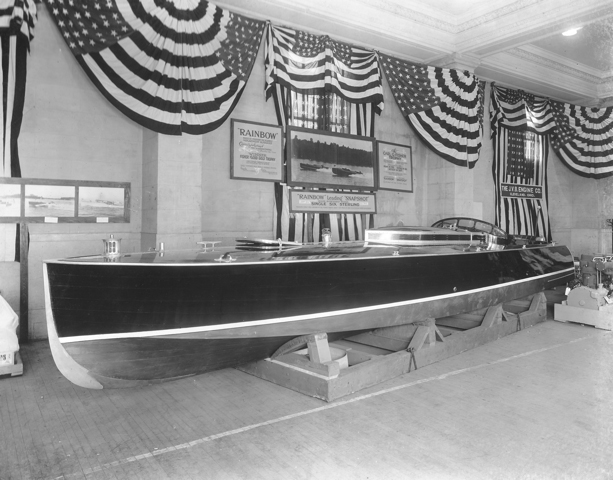
In 1919, Greening commissioned the Rainbow, designed by George Crouch, and built by Ditchburn in Gravenhurst.
It was the first of seven racing Rainbows, and established a decade-long relationship between the master builder and the gentleman racer, resulting in international fame for Canada.
In the race, Greening dominated the field. His intuitive mechanical genius recognized the advantage of engine balancing and lightweight aluminum pistons, adding significant horsepower.
This attention to detail and efficiency were hallmarks of Harry’s racing success.Next, Rainbow II put into practice theories of surface props, where only one half of the propeller is in the water.
Her success was in knowledge gained after she hit a wave in a race and sank.

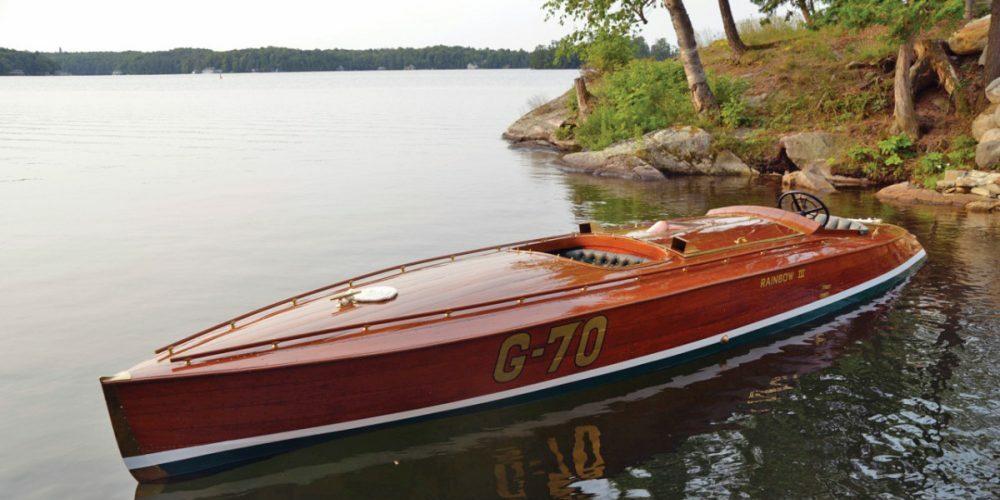
In 1923, Greening entered Rainbow III in the Gold Cup races in Detroit. Designed by John Hacker and built by Ditchburn, it sported a Packard aircraft–derived lightweight engine, and an external prop and rudder, the first in a planing hull.
Greening won the first two heats, but a broken cotter pin robbed him of victory. He then took the boat to Muskoka, where he ran 1064 miles in 24 hours, shattering all existing records.
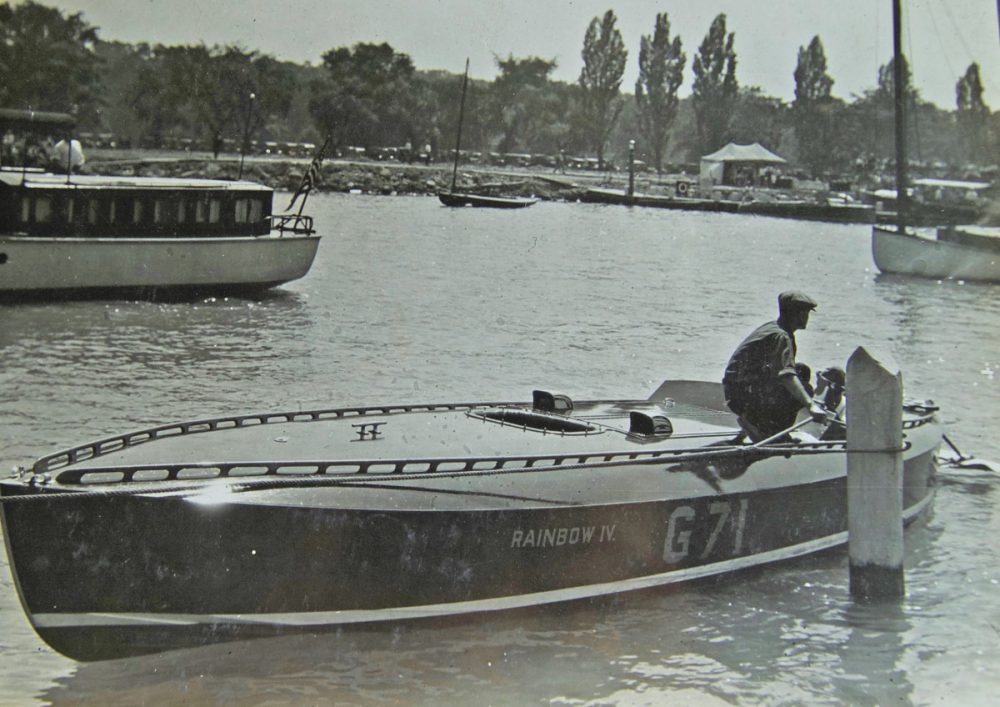
His next boat, Rainbow IV, was both his most advanced and most controversial.
The dory-shaped lap strake hull carried a lightweight Packard engine driving a surface prop, and a lap strake bottom. Although previously approved by the race committee, a protest after Greening won the race was upheld.
Ever the gentleman, he withdrew from competition, returned to Muskoka, and set another endurance record at an average of 50 mph.

Greening then represented Canada at the Duke of York Trophy Races in England in Rainbow V.
The boat was the fastest entrant, but hit a log in the Thames River.
There’s a gap here, as we know nothing about Rainbow VI which was a failed experiment.
Rainbow VII was Greening’s biggest and perhaps best. He returned to Detroit in 1928 to capture the Lipton Trophy, and had the effrontery to bring eight friends along for the ride.
Once again an endurance record was set by this remarkable boat at an average of 63 mph for 12 hours.
Although he retired from racing in 1929, Harry continued to be involved with boats and had a radical design on the drawing board at the time of his death at age 80.
Greening’s Rainbow IX and Rainbow X are still enjoyed in Muskoka to this day.
Harry Greening’s legacy can be seen in surviving examples and faithful replicas. His innovations, speed, and endurance records brought international recognition to Canada.
